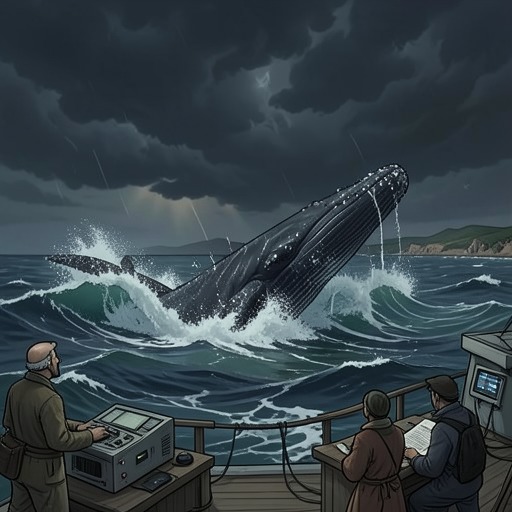
2006 Thames whale incident
The WhaleThe 2006 Thames whale incident brought a deep-ocean animal into the crowded waterways of a modern city, where rescue, spectacle, and helplessness became inseparable. A northern bottlenose whale moved with the tides through the River Thames, passing prominent landmarks before stranding; the attempt to return her to the sea ended in death near Gravesend. The episode made visible both the distance between whales and human worlds and the human impulse to interpret, display, and save an animal whose needs remained poorly understood.
Entry into the city
The whale’s appearance was startling in part because of the route she took. She passed under Waterloo Bridge and Charing Cross, near the place where Herman Melville had stayed, and by the Palace of Westminster before stranding on the Battersea embankment. Her movement through the estuary and upstream was governed by the tides, while the landmarks along the banks placed her in the midst of a densely inhabited urban landscape.
The city was not simply a backdrop. The whale, accustomed to the booms and clicks of other whales in the open sea, encountered the noise and confinement of a major metropolis. Crowds shouted; boats gathered around her; helicopters carrying film crews circled overhead. News images carried the event to audiences around the world, turning a distressed animal’s movements into a public spectacle.
The episode also unsettled the ordinary separation between sea and city. The ocean can seem, to people travelling over or alongside it, merely a distance to cross, though it remains a vast and changing environment. Here, a creature from that largely unseen world appeared within reach of bridges, embankments, and spectators. The encounter made the city’s waterways seem less like controlled infrastructure than an opening through which the unruly sea could intrude.
Rescue and death
The whale moved up and down the river with the tides, her flukes moving frantically and her head rising above the water. The rescue effort eventually lifted her onto an inflated pontoon and carried her back downriver in a procession watched by crowds on the bridges and by news crews. The journey toward the sea offered the possibility of escape, but the animal’s muscular movements began to weaken as she lay on the pontoon.
At seven o’clock that evening, near Gravesend and about two hours from freedom, she died. Her attendants, in tears, asked that the cameras be turned off. The request marked a shift in the event’s public character: the same cameras that had transmitted the rescue as spectacle were asked to withdraw in recognition of the whale’s death. The attempt to help her had not overcome the dangers of her condition or surroundings.
The incident’s physical outcome clarified what the dramatic images could obscure. A necropsy found that the whale died from dehydration and stress. Months later, Richard Sabin showed Philip Hoare her preserved dorsal fin at the Natural History Museum. The fin was wrinkled and greyish black, with its central cartilage exposed where it had been removed; it remained bent to one side, a trace of the trauma of the whale’s final days. The specimen preserved evidence of distress that the spectacle of the rescue could not itself explain.
Public meanings and earlier echoes
The whale’s death prompted sharply different public readings. Some newspapers treated the incident as a test of human compassion, while others saw it as a reminder of the brutality of nations that continued to hunt whales. The event was compared to the funeral procession of Winston Churchill, and newspaper coverage took on a commemorative tone. At the same time, cartoons made the public pageantry itself an object of satire, imagining photographers positioned around the whale as if she were a royal figure lying in state.
The event also revived an older pattern of turning whales into public objects. A cartoonist’s image echoed the earlier display of a beluga at the Royal Aquarium, another whale whose sex had been misidentified and whose presence in Westminster had made it an attraction. These echoes do not make the two incidents identical, but they show how the appearance of a whale in an urban setting repeatedly invites audiences to treat an animal as spectacle, symbol, or civic occasion.
Religious interpretation entered the debate by coincidence. The Sunday Mass reading came from the Book of Jonah, and a clergyman connected the story of Nineveh with the whale’s appearance, presenting it as a possible warning about consumption, global warming, and violence. Such readings made the animal an omen; the necropsy, by contrast, recorded the immediate physical causes of her death. The two responses reveal the pull between treating a whale as a sign addressed to humanity and attending to the individual animal’s material suffering.
The incident in a longer history
The Thames visitation occurred against a history in which human relations with whales had long been shaped by their commercial uses. Petroleum from the well Edwin L. Drake drilled at Titusville in 1859 helped displace whale oil as a source of illumination, but the retreat from one use did not end the exploitation of whales. In 1868, Sven Foyn patented a grenade harpoon that enabled the pursuit of large, fast rorquals; later, Antarctic whaling supplied material for explosives. During the global wars, tens of thousands of whales were killed, and the South Atlantic humpback population was driven to extinction by 1918. These histories do not explain why the northern bottlenose whale entered the Thames, but they complicate any simple story of humans as the animal’s rescuers: people had also built industries and technologies around killing whales.
The whale’s appearance was therefore read within a wider anxiety about the condition of the natural world. Around the time of the Thames incident, unusual whale appearances and strandings elsewhere were also being interpreted as signs of disturbance. The Thames whale became especially powerful as a public image because the causes of her death were documented while the larger meanings of her arrival remained contested. She was at once a living animal in distress, the subject of a failed rescue, and a screen for arguments about human conduct. Her preserved fin offered no prophecy; its bent shape instead held the evidence of what had happened to one whale in the final hours of her life.